
Phone Thiha Kyaw
Ph.D. StudentDepartment: Current Students, PhD Students

Phone develops geometric methods for robot motion planning and task-level behaviours. A robot’s configuration space is rarely flat. A Riemannian metric, such as the kinetic-energy metric given by the robot’s mass matrix, makes some motions cost more than others. Task constraints confine the robot to curved submanifolds, and each contact the robot makes or breaks changes the dimension of the manifold the robot operates on. His research turns this structure into planners that reason about continuous motion and discrete decisions together, drawing on ideas from differential geometry.
Before graduate school, Phone built autonomy software stacks and large-scale robotic deployments at Dyson and LionsBot International in Singapore. You can find out more about him here.
Research
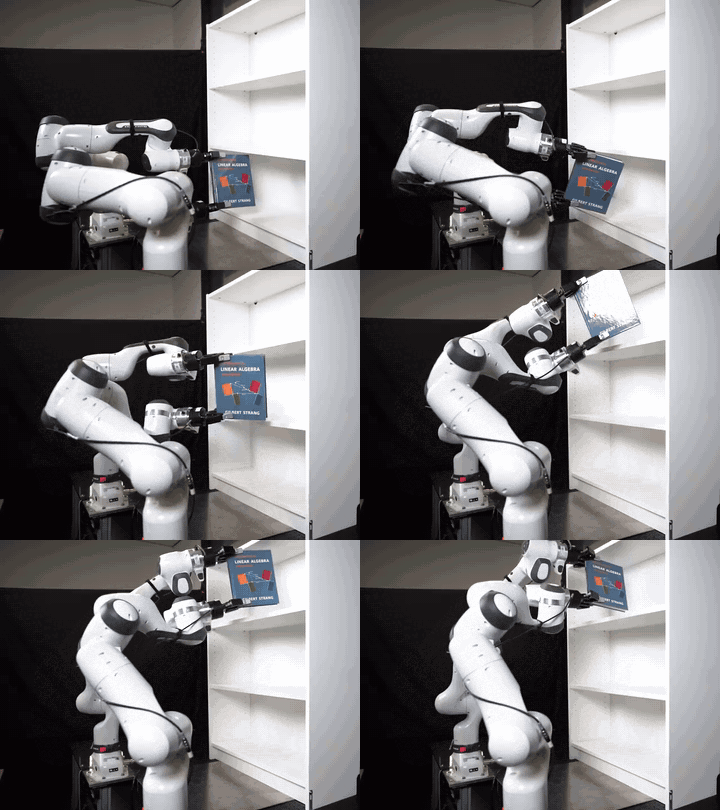
Motion planning with Riemannian metrics
Motion planning algorithms often assume a flat Euclidean configuration space, yet for many robots the configuration space is a non-Euclidean manifold, and end-effector task constraints further confine motion to curved submanifolds. We generalize existing planning algorithms, from sampling-based planners to trajectory optimizers, to work on Riemannian manifolds for any choice of metric, so that the plans they find respect this geometry.
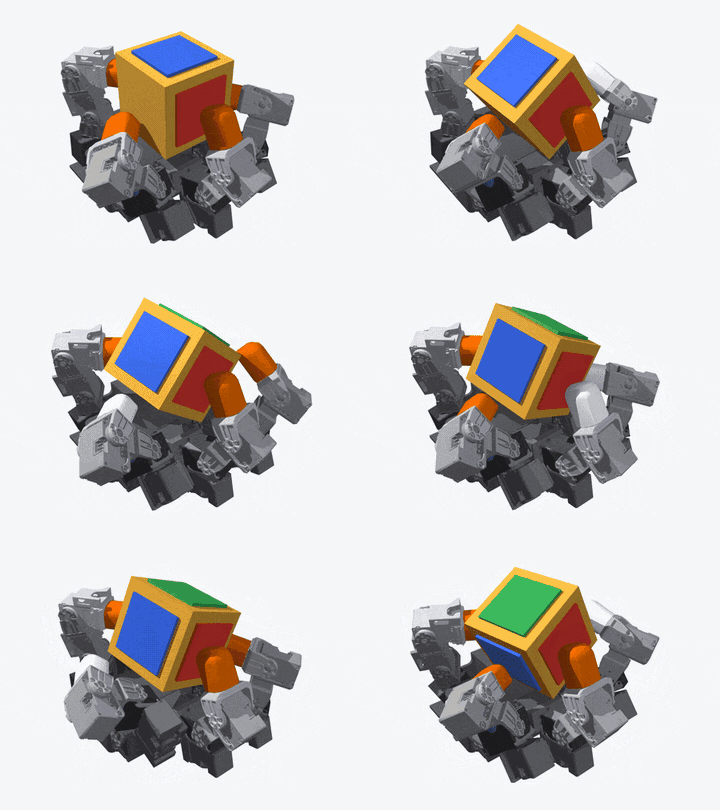
Discrete–continuous planning on stratified configuration spaces
Contact-rich manipulation and other task-level behaviours combine discrete decisions, such as which contacts to make or break, with continuous motion. Contacts split the configuration space into strata, manifolds of different dimensions joined along their boundaries. We study this stratified representation and how it can let a planner make discrete and continuous decisions together, without a hand-designed mode sequence.
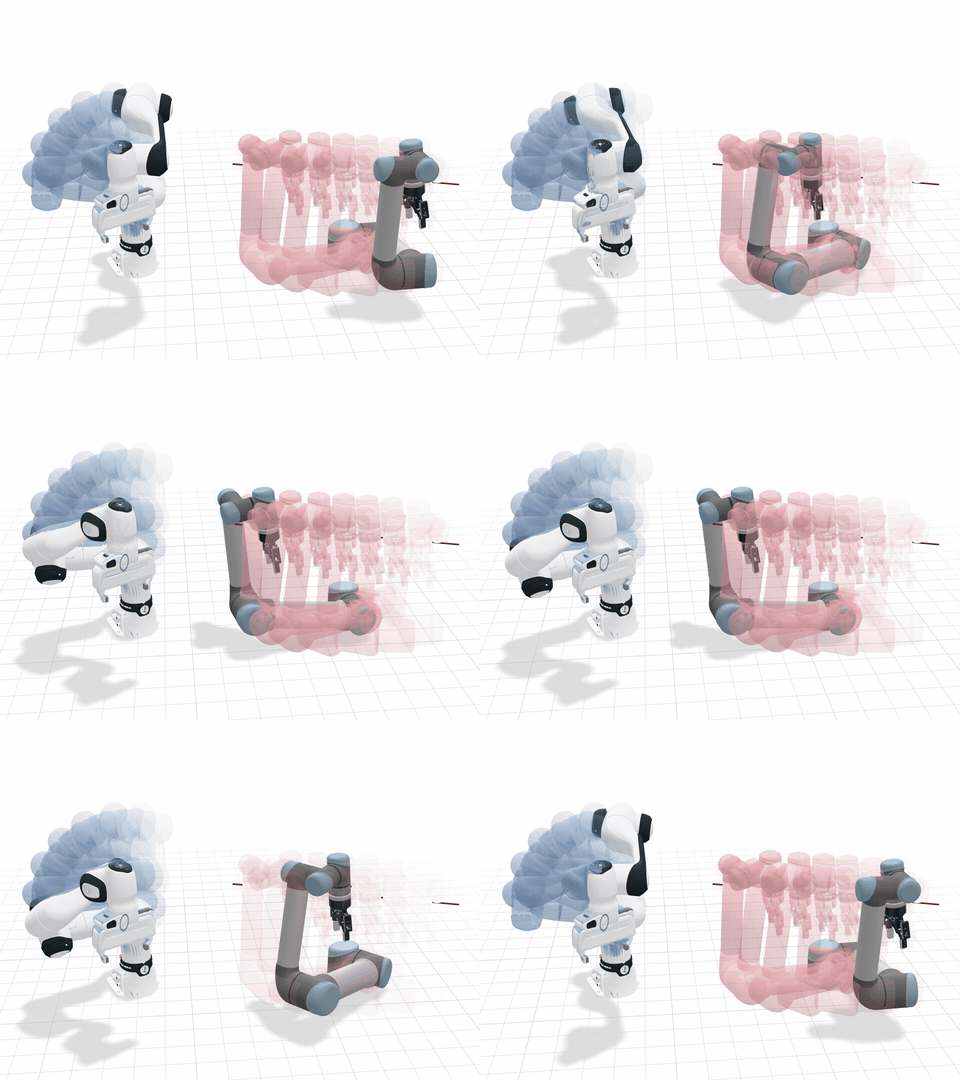
Geometry of learned models
Diffusion models and other generative models are increasingly used to generate robot configurations and motions. We study the geometric structure that these models learn and how it can guide planning, using settings such as constrained inverse kinematics, where the intrinsic geometry of every solution manifold is known analytically.
Recent publications
- Induced Riemannian Metrics for Motion Planning with Constraints
- Contact Modes Are Strata: What Geometric Structure Buys in Discrete–Continuous Planning
- Lost in Time? Continuous Symmetry and Identifiability in Aided Inertial Navigation with Unknown Measurement Delays
- Exploring the Intrinsic Geometry of Diffusion Models with Constrained Inverse Kinematics
- Direct Informed Sampling on Riemannian Manifolds via Loewner Order Lower Bounds
- Geometry-Aware Sampling-Based Motion Planning on Riemannian Manifolds
- Greedy Heuristics for Sampling-Based Motion Planning in High-Dimensional State Spaces