
Miguel Rogel
Ph.D. StudentDepartment: Current Students, PhD Students
Miguel is studying planning and control for human-robot interaction, with a focus on force control. His recent work examines the geometry that generative models learn about robot motion, showing how diffusion models capture the solution manifolds of constrained inverse kinematics (CoRL 2026), and he contributes to the lab’s work on Riemannian motion planning, physics-guided placement, and force-torque sensor bias estimation.
Exploring the Intrinsic Geometry of Diffusion Models with Constrained Inverse Kinematics
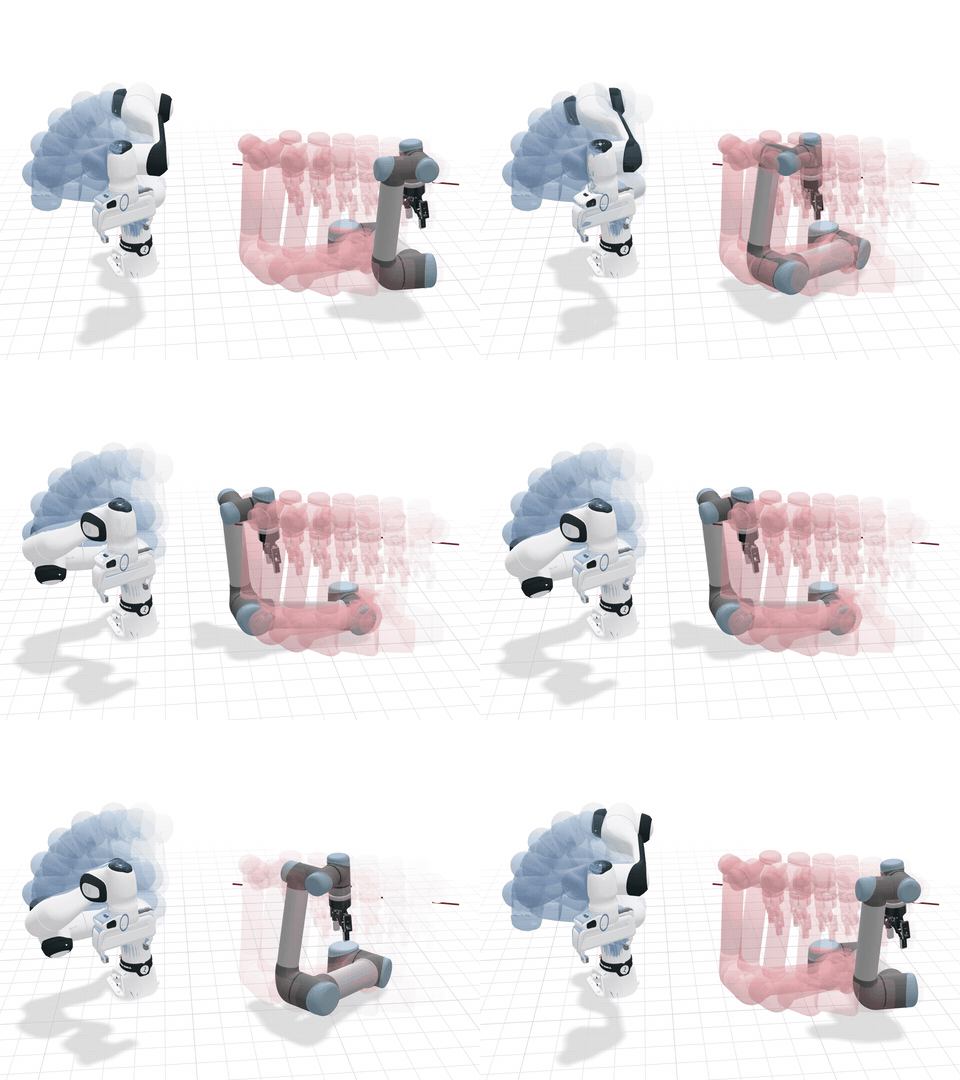
Miguel Angel Rogel Garcia, Phone Thiha Kyaw, Jonathan Kelly
Conference on Robot Learning (CoRL), 2026
Also presented at the RSS 2026 Workshop on Diffusion for Robot Learning
Abstract: Recent studies suggest that diffusion models can recover geometric structure in the data they are trained on, yet the supporting evidence has so far come mostly from natural-image data, where the underlying geometry itself is unknown. We study this question in a setting where the geometry is analytically tractable: constrained inverse kinematics (IK).
Induced Riemannian Metrics for Motion Planning with Constraints
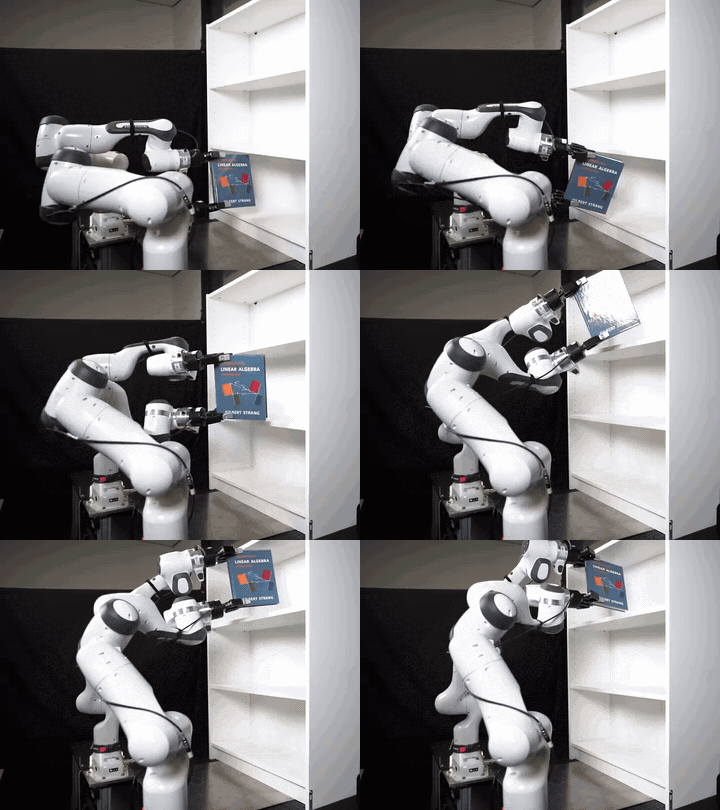
Phone Thiha Kyaw, Thomas Cohn, Miguel Angel Rogel Garcia, Jonathan Kelly
arXiv preprint, 2026
Abstract: In constrained motion planning problems, task and loop-closure constraints restrict a robot's motion to a curved, lower-dimensional submanifold of its configuration space. Planners measure path length with a metric, which sets the cost of moving in each direction.
Generating Stable Placements via Physics-guided Diffusion Models
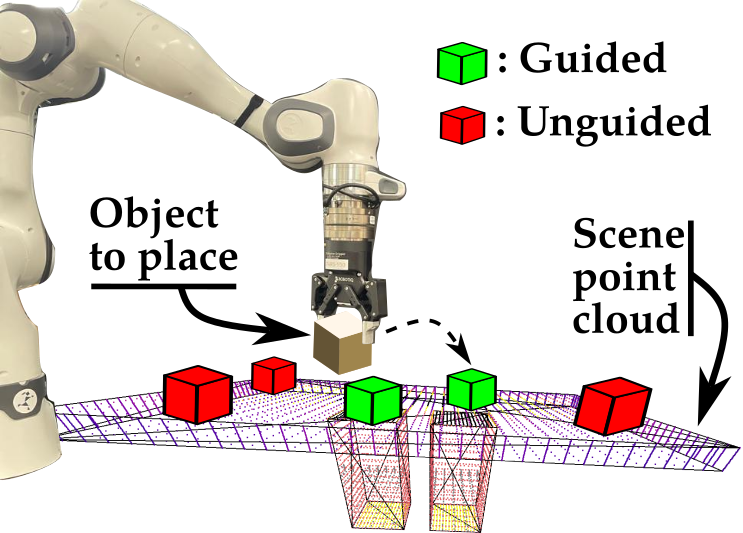
Philippe Nadeau, Miguel Rogel, Ivan Bilic, Ivan Petrovic, Jonathan Kelly
arXiv preprint, 2025
Abstract: Stably placing an object in a multi-object scene is a fundamental challenge in robotic manipulation, as placements must be penetration-free, establish precise surface contact, and result in a force equilibrium. To assess stability, existing methods rely on running a simulation engine or resort to heuristic, appearance-based assessments.
Residual Reward Models for Preference-based Reinforcement Learning
C. Cao, M. Rogel-Garcia, M. Nabail, X. Wang, N. Rhinehart
2025
Automated Continuous Force-Torque Sensor Bias Estimation
Philippe Nadeau, Miguel Rogel Garcia, Emmett Wise, Jonathan Kelly
arXiv preprint, 2024
Abstract: Six axis force-torque sensors are commonly attached to the wrist of serial robots to measure the external forces and torques acting on the robot's end-effector. These measurements are used for load identification, contact detection, and human-robot interaction amongst other applications.